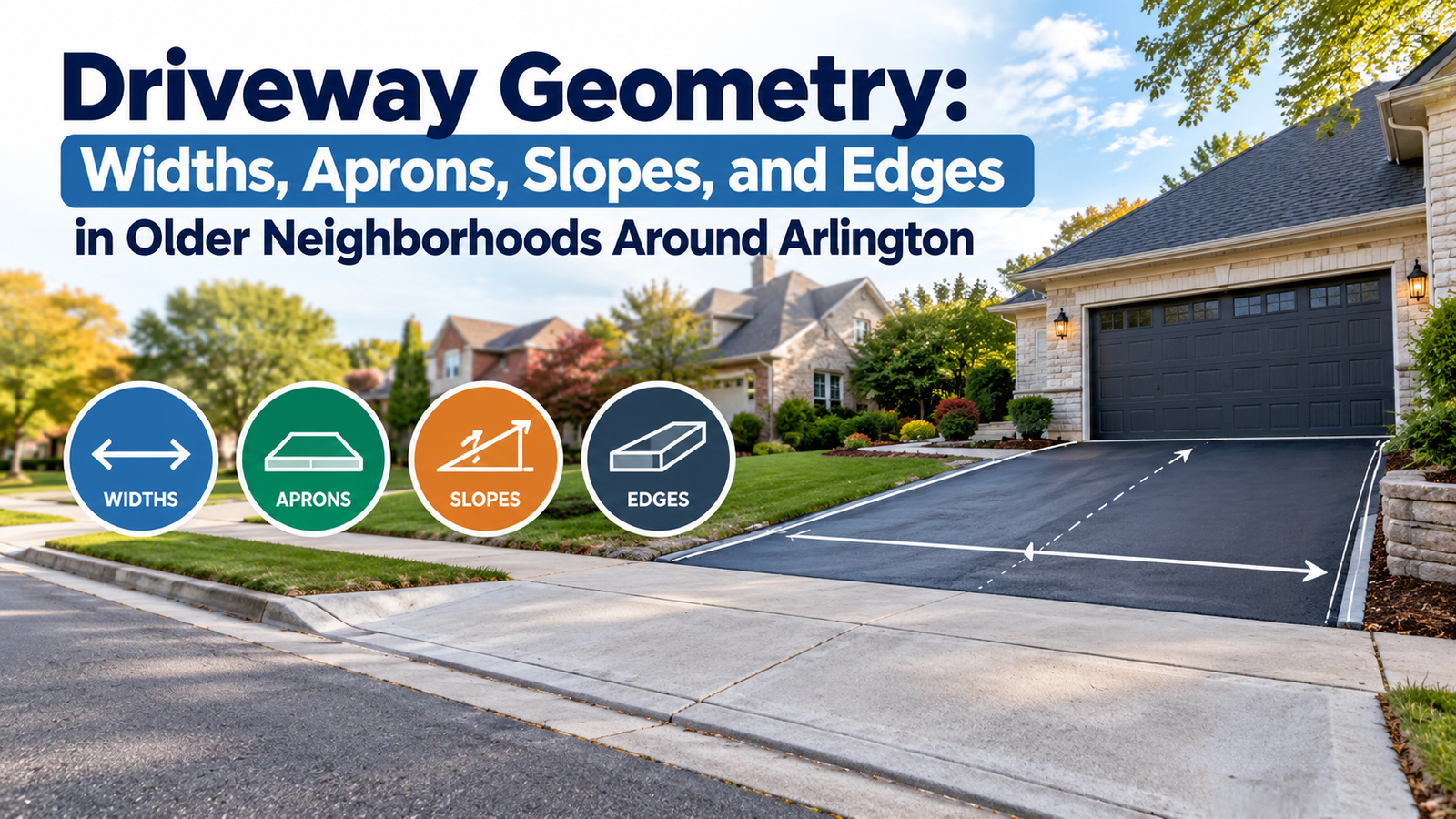
When people think about a driveway, they usually think about the surface. Is it smooth, is it cracked, is it black or gray? Yet the shape of a driveway often matters just as much as its material. How wide it is, where it meets the street, how steeply it climbs or dips, where the water goes, and how the edges are supported all influence how well it works day to day and how long it lasts. These geometric details are rarely discussed outside the trade, but they explain why two driveways made of the same asphalt can behave very differently.
This guide looks at driveway geometry in general terms and applies it to the older residential neighborhoods around Paving Contractor Arlington, in the Warwick area of Rhode Island, where many homes date from the mid twentieth century and lots are modest in size. It covers widths and turning space, the apron where driveway meets road, slopes and drainage, edge treatment, and the practical issues that come from tight lots and older streets. It is a general discussion that does not set a design for any particular home, and local rules vary, so questions about permitted dimensions are best taken to the city.
Why Shape Matters as Much as Surface
A driveway is a small piece of civil engineering. It must carry vehicles, shed water, connect smoothly to the street, and fit within a lot that already has a house, utilities, trees, and a neighbor next door. When any of those relationships goes wrong, the pavement suffers.
- A driveway that is too narrow invites vehicles to drive on the edges, where the pavement is weakest.
- A driveway that slopes toward the house sends water to the foundation.
- A driveway with an abrupt transition at the street scrapes bumpers and breaks down at the joint.
- A driveway with unsupported edges crumbles at the sides no matter how good the asphalt is.
Getting the geometry right is therefore not decoration. It is the framework on which the surface depends.
Width and Turning Space
Straight Width
Residential driveways are commonly built in a range of widths, with single car driveways often around nine to ten feet and two car driveways around eighteen to twenty feet, though these are rough conventions and not rules. A narrow driveway squeezes car doors against walls or plantings. A very wide one adds pavement that must be maintained and increases runoff.
Turning Radius
Vehicles turn in arcs, not right angles. The inside rear wheel tracks inside the front wheels, so a driveway with a sharp bend needs a wide curve. Larger vehicles such as pickups and vans need more room than small cars. Poorly planned curves lead to vehicles cutting corners across lawns and breaking pavement edges.
Parking and Turnarounds
In a lot where backing onto a busy street is risky, a turnaround area, such as a hammerhead or a loop, lets cars exit forward. On compact lots this may be impractical, but even a modest widening near the garage can help.
Walkway and Door Clearance
Space beside parked cars matters. A common thought is to leave enough room to open doors and walk to the house without stepping onto soil or plantings, which otherwise causes edge damage.
The Apron: Where Driveway Meets Street
The driveway apron, sometimes called the curb cut or approach, is the section that crosses the edge of the road and the sidewalk or planting strip. It is one of the most heavily stressed and most regulated parts.
Public right of way. In most cities, including Warwick, the apron lies partly in the public right of way, so work there is typically subject to municipal permits and standards. Requirements can include dimensions, materials, and how the sidewalk is treated.
Grade transitions. A vehicle moves from road level to driveway level through a short ramp. If the change in slope is too abrupt, front bumpers scrape or rear ends drag. Designers use gradual transitions, often a vertical curve, to ease it.
Drainage at the road. Water should not run from the driveway onto the road in a sheet, nor from the road into the driveway. A subtle crown or gutter alignment can help.
Heavy loading. Because cars turn and brake at this point, the apron sees more shear stress than the middle of the driveway. A stronger base is a frequent solution.
Joint with the road. The seam between new driveway pavement and the road edge is a classic crack location. Clean cuts, tack coat, and tight compaction help it hold.
Slope and Longitudinal Grade
The steepness of a driveway along its length is the longitudinal grade. A flat driveway risks standing water. A steep one challenges vehicles and snow removal.
Minimums. Most pavements need at least a slight slope, commonly cited at around one to two percent, so that water moves rather than ponds.
Maximums. Many guidelines suggest keeping residential driveways below about ten to twelve percent, with steeper grades possible but trickier. Steep driveways are harder in winter, and very abrupt breaks in grade can cause low slung vehicles to scrape.
Breakover. The point where a slope changes direction is called a break. Sharp breaks can cause underbody contact, so they are smoothed with vertical curves.
Winter performance. Ice and snow make slope a safety factor. Driveways that face north or run in shade hold ice longer.
Rhode Island’s older neighborhoods often have lots that are fairly level, but pockets of rolling terrain exist, and driveways may step up from the street.
Cross Slope and Crown
Cross slope refers to the tilt across the width of the driveway. A single direction slope, a crown in the middle, or a side-to-side tilt can all be used to shed water.
- One-way slope. The surface tilts to one side, easy to build, and directs water to a chosen edge.
- Crown. The center is slightly higher than the edges, and water runs to both sides.
- Inverted crown. The center is lower, with water collecting along the middle, sometimes used with a drain.
Typical cross slopes are small, often in the range of one to three percent. Too much makes parked cars lean and complicates opening doors. Too little leaves water sitting.
Where the Water Goes
Every driveway shape has a drainage story.
Away from the house. The first rule is to direct water away from the foundation. A driveway that runs toward a garage or basement entry needs a trench drain, catch basin, or regrading.
Away from neighbors. Water should not be sent onto adjoining property. Many municipalities have rules about that.
To a safe outlet. Lawns, planting beds, swales, and storm drains are possible destinations, depending on lot size and local rules.
Not into the street if avoidable. Some jurisdictions discourage or restrict directing large volumes of driveway runoff onto public roads.
Roof runoff. Downspouts that discharge across a driveway add to water load and winter ice.
Older neighborhoods around Warwick often have limited stormwater infrastructure by modern standards, which makes on-lot management more relevant.
Edges and Lateral Support
Asphalt does not stand up well at unsupported edges. The surface is compacted from above, and at the perimeter there is nothing to resist outward movement. Over time, edges crack, crumble, and ravel.
Common edge supports.
- A compacted shoulder of gravel or soil that matches the pavement height
- A concrete curb or header
- Granite or precast curbing
- Landscape timbers or pavers set in place
- Thickened asphalt edge, built slightly wider and deeper
Common edge problems.
- Soil erosion beside the pavement
- Lawn growing over the edge and holding moisture
- Vehicles driving on the edge
- Plow blades catching the lip
Keeping a shoulder filled and graded flush often extends edge life considerably.
Fitting a Driveway Into a Tight Lot
Neighborhoods developed in the 1940s through 1960s were built when families had one car and houses sat close together. Today, many households have two or three vehicles, and driveways have been widened, extended, or relocated. A few recurring challenges appear.
Side yard constraints. Setbacks from property lines may limit widening.
Impervious area limits. Some towns limit how much of a lot can be paved, especially in sensitive areas.
Utility locations. Water meters, gas lines, electric service, and sewer cleanouts may sit under or near the driveway. Calling 811 before excavation is standard practice.
Street trees and sidewalks. Curb cuts must account for these, and removal of public trees generally requires approval.
Neighbor relations. Drainage, snow storage, and shared boundaries can create friction.
Historic character. Some areas value traditional appearances such as narrow driveways or ribbon strips, and they may carry guidance.
Snow Management
In southern New England, driveway geometry influences how well snow can be handled.
- Storage space. Snow has to go somewhere. Lawns and planted areas near the edges serve, but they can be damaged by salt and plowing.
- Plow turns. Curved or irregular edges are hard to plow cleanly.
- Markers. Stakes mark the edge so plows and snowblowers avoid the lawn.
- Meltwater. As snow melts, water should have a route away.
Driveways with poor drainage tend to develop ice sheets where meltwater refreezes.
Surface Choices and Geometry
The shape and the material interact. Asphalt tolerates gentle curves and subtle slopes well, because it can be rolled into smooth contours. Concrete requires jointing patterns that influence layout. Pavers allow decorative shapes but demand edge restraint. Gravel needs stable edges and enough slope to avoid washouts. In all cases, careful geometry makes the material work better.
Safety and Visibility
Beyond durability, geometry supports safety.
- Sight lines. Fences, hedges, and parked vehicles can obscure views of pedestrians and traffic when backing out.
- Sidewalk crossings. Slopes and transitions at sidewalks should remain accessible and smooth.
- Lighting. Illumination near the apron and garage reduces risks at night.
- Surface traction. Texture and slope affect slipping on wet or icy days.
The Arlington Context
Arlington is an older residential area on the Warwick side of the Providence metropolitan region, and its features are typical of many Rhode Island neighborhoods built in the postwar decades.
Smaller lots. Houses sit close to the street and to each other, leaving limited room for wide driveways.
Mature landscaping. Established trees contribute shade, roots, and falling debris.
Mixed driveway ages. Some driveways are decades old with several repairs, while others have been recently replaced or extended.
Varied materials. Asphalt is common, but concrete strips, gravel, and pavers appear.
Winter conditions. Freeze and thaw cycles, plowing, and salt all affect driveway edges and aprons.
Shared infrastructure. Older streets may have narrow pavement, limited gutters, and aging utilities beneath the road and apron.
Because of these conditions, geometric details such as apron design, edge support, and drainage have an outsized influence on how driveways age.
Common Misunderstandings
“A wider driveway is always better.” Added width increases runoff and upkeep, and only helps if it is used.
“Flat is best.” A completely flat driveway holds water. A slight slope is needed.
“The apron is just the end of the driveway.” It is a distinct, heavily loaded, often regulated element.
“Edges don’t matter.” Unsupported edges are among the most frequent failure points.
“Drainage is only a big-project concern.” Even a small driveway can send water to a basement.
Frequently Asked Questions
How wide should a residential driveway be?
Common single car widths are around nine to ten feet and two car widths around eighteen to twenty feet, though lot conditions and local rules influence the choice.
What is a driveway apron?
The part of the driveway that crosses the curb or road edge and often the sidewalk. It is usually partly within the public right of way.
What slope is best for a driveway?
A gentle slope, at least one or two percent for drainage, and generally not much steeper than ten to twelve percent for ease of use and safety.
Why do driveway edges crumble?
Asphalt at the perimeter lacks lateral support, and erosion, moisture, vehicle loads, and plows all push the edge outward.
Do I need a permit to change a driveway?
It depends on the municipality and what is being changed. Work in the right of way, new curb cuts, and expansions of paved area commonly involve review.
How do I stop water from running into my garage?
Drainage is typically addressed by regrading the pavement, adding a trench drain or catch basin, or redirecting runoff.
What is a vertical curve in a driveway?
A gradual change in slope that prevents scraping where a driveway meets the street or where grades change.
Why does the seam between the driveway and the road crack?
The joint sees heavy turning loads, temperature movement, and water entry, and it joins two pavements built at different times.
Final Thoughts
A driveway is a shape as well as a surface. Width, curve, apron, slope, crown, drainage, and edge support all work together, and a weakness in any of them shows up as cracking, ponding, or crumbling long before the asphalt itself wears out. In older neighborhoods with tight lots and aging streets, these details matter more, not less.
For readers exploring what a paving contractor in Arlington deals with day to day, geometry offers a useful lens. The questions of where the water goes, how the apron meets the road, and what supports the edge are the same ones that shape pavement from one block to the next, and they explain much of what separates a driveway that lasts from one that struggles.